EverTrust

A community-centered approach to financial stability built on shared learning, collective stewardship, and real-world value.
EverTrust Community Collective is not about escaping the system overnight or chaining high returns. It is about understanding how money actually works, how institutions quietly use collective capital, and how everyday people can begin learning; together; how to protect, store, and grow value responsibly over time.
This page explores ideas around shared ownership, trust-based structures, and asset-backed thinking; specifically for individuals and families on tight margins, where stability matters more than speculation.
A Collective Approach to Real-World Assets
At its core, the EverTrust Community Colllective concept explores how collective thinking has historically been used to protect and steward real-world value.
Throughout history, families, communities, cooperatives, and institutions have relied on shared ownership of tangible, productive assets to reduce individual risk and increase long-term stability.
This section exists to examine why collective approaches are studied; not to present a finalized structure or outcome.
The focus is on understanding principles such as shared responsibility, disciplined accumulation, transparency, and long-term stewardship, especially for individuals and families living with limited financial margin.
This is an educational exploration of ideas, not an operational plan or financial system.
Why an Extra $500/Month Matters
For many people, an extra $500 per month would not create wealth; it would create breathing room.
It could mean avoiding late fees, reducing reliance on credit, covering a temporary shortfall, or handling an unexpected expense without financial crisis.
This concept is not built around the idea hat every participant receives the same support at all times. Instead, it explores how a collectively stewarded system might provide stability and backup; especially for those facing periods of financial strain.
Some members may never need that level of support. Others may need it temporarily. The shared goal is not equal payouts, but share resilience.
The purpose is not financial escape or guaranteed income.
The purpose is financial relief when it matters most, improved predictability, and a community-based safety layer built slowly, responsibly, and with care.
Education Before Participation
True financial independence begins with understanding.
This space is dedicated to learning about how money systems operate, how collective capital is used by institutions, and how alternative ownership models can be structured responsibly.
Topics explored include:
- Cooperative ownership
- Trust-based frameworks
- Asset-backed strategies
- Long-term stewardship
How These Ideas Connect
Together, these ideas form a single framework:
Understanding systemic risk, redefining value, learning how collective stewardship works, and prioritizing long-term stability over scale or speculation.
None of these ideas stand alone. Each informs how individuals and families can think differently about financial security; especially when resources are limited.
The framework is intentionally modest, realistic, and grounded in education first.
What This Page Is; and Is Not
This page introduces a community trust concept focused on tangible assets and long-term stability. It exists to build understanding and alignment before any structure is finalized or participation is offered.
This page is:
- An educational overview of a community trust concepts
- A high-level exploration of collective ownership
- A place to learn principles like stewardship, transparency, and long-term thinking
- An early-stage orientation space for ideas under consideration
This page is not:
- A finalized trust or legal structure
- An investment offer or solicitation
- A guarantee of income, returns, or outcomes
- Financial, legal, or tax advice
- A request for funds
If future participation opportunities are ever developed, they will be presented separately with clear terms, disclosures, and documentation.
The Structure
Purpose:
To separate people from assets, and assets from emotion, impulse, and individual risk.
Conceptual Framing:
At the center of the model is a community trust or trust-like structure designed to hold and steward shared assets on behalf of participants.
The trust exists to provide continuity, governance, and protection; not to maximize short-term gains.
Key Ideas:
- Assets are held collectively, not individually
- Decisions are guided by predefined principals (stability, preservation, transparency)
- No single participant controls the assets
- Rules exist before participation, not after outcomes
Collective Pooling
Purpose:
To allow small, manageable contributions over time into a shared pool.
Conceptual Explanation:
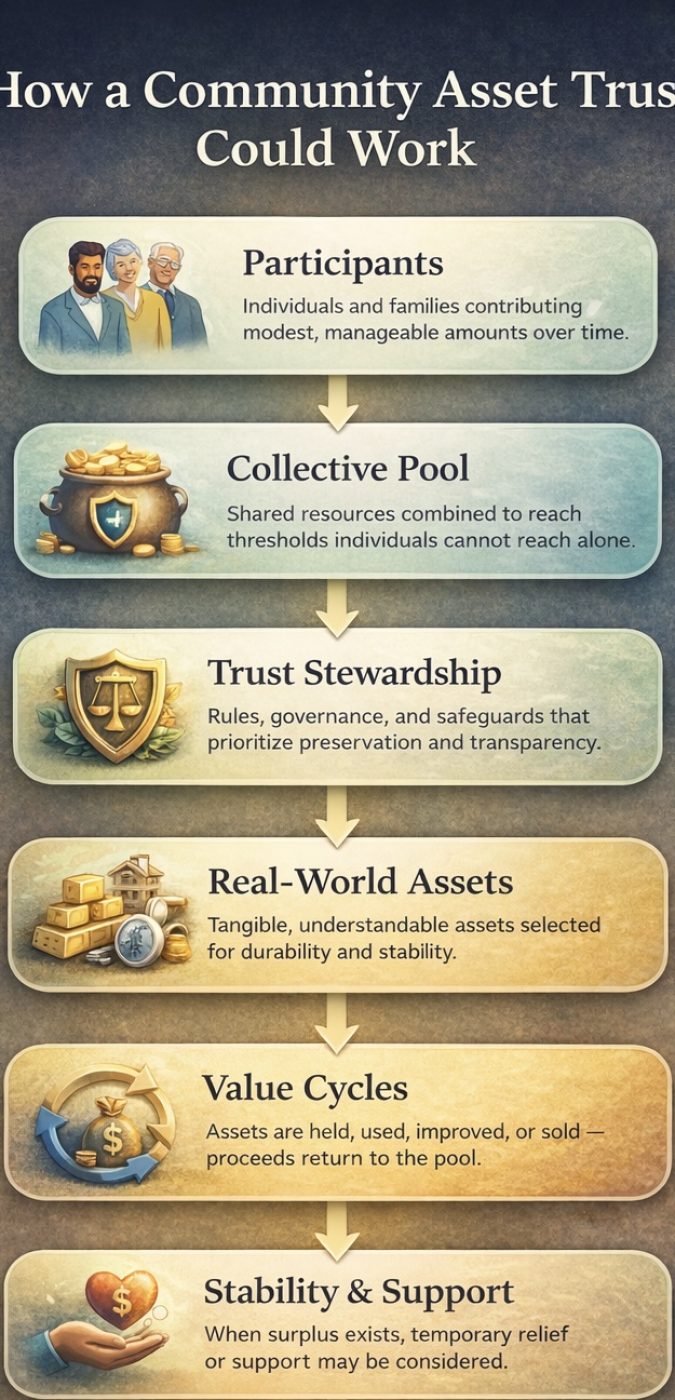
Participants contribute modest amounts over time into a shared pool.
/individually, these amounts may not be sufficient to access certain assets. Collectively, they become capable of acquiring real, tangible value.
Critical Reframes:
- Contributions are manageable, not burdensome
- Participation can be periodic, not constant
- The pool grows gradually through consistency, not urgency
Asset Acquisition
Purpose:
To convert pooled value into productive or value-retaining assets.
Educational Framing:
Over time, pooled resources may be used to acquire tangible assets that historically retain value or produce income. These assets are selected for durability, understandability, and long-term usefulness; not speculation.
Asset Categories:
- Precious metals
- Income-producing physical assets
- Undervalued or stable real-world goods
- Assets with low complexity and clear ownership
Key Constraint Emphasis:
Assets selection prioritizes preservation first, growth second.
Investment-Profit Cycles
Purpose:
To explain how money can move without promising that it will.
Neutral, Accurate Framing:
some asset may generate income through use, leasing, resale, or appreciation over time. When assets are sold or produce excess value, proceeds return to the collective pool.
Important Clarity Points:
- Not all assets are sold
- Not all cycles are short
- Some assets are held indefinitely
- Profit is episodic, not guaranteed or constant
Cycle Visualization:
- Pool accumulates resources
- Asset is acquired
- Asset is held, used, or improved
- Value is realized (Income or sale)
- Proceeds return to the pool
- Pool strengthens future capacity
This reinforces continuity, not payout expectation.
Possible Distributions
In some models, when the collective pool produces surplus beyond preservation needs, distributions may be considered. These are not automatic, equal, or guaranteed.
Distribution Principals:
- Priority to system stability
- Consideration of individual circumstances
- Temporary support over permanent dependency
- Transparency over speed
in certain circumstances, temporary monthly support; such as a $500 supplement; could represent relief rather than income. This is an example of what stability support might look like, not a promise of outcome.
Why This Is Slow by Design
This framework is intentionally designed to move slowly.
Speed favors speculation, leverage, and fragility. Stability favors patience, discipline, and clear rules.
Traditional financial systems grow quickly by taking on hidden risk, externalizing losses, and prioritizing short-term returns. Titus model explores the opposite approach; gradual accumulation, careful asset selection, and long-term stewardship.
Slowness Allows:
- Time to build trust before capital is deployed
- Time to learn before decisions are made
- Time to absorb setbacks without collapse
- Time for assets to mature instead of being rushed to sale
This is not a system for chasing opportunity, it is a system for reducing vulnerability.
Progress is measured in resilience, not speed.
Express Interest In Learning More
Submitting this form indicates interest in learning and discussion only.
It does not imply participation, investment, or commitment of any kind.
Participation does not constitute an offer or solicitation of securities. All opportunities are conceptual unless explicitly stated otherwise.
